Reformer Pilates Instructor Course UK: Do You Need Mat Training First?
If you’re weighing up a Reformer Pilates instructor course in the UK, here’s the short answer: no, you don’t need a Mat qualification first. On our courses, Mat and Reformer each stand on their own, and which one you start with depends on how and where you picture yourself teaching, not on ticking one off before the other.
It’s one of the first things people ask when they get in touch, right up there with “when’s the next course” and “can I fit this around my job.” Reasonable questions, every one of them. So let’s take this one properly.
Why the assumption persists
Plenty of fitness and movement qualifications in the UK are built as ladders: level one before level two, foundation before advanced. That’s a sensible structure for lots of things, so it’s a sensible question to ask about Pilates teacher training too. The honest answer, for us, is that Mat and Reformer aren’t a ladder. They’re two different rooms in the same building, each teaching you to read and cue a body using a different piece of apparatus.
A thinking teacher works out what’s true for the body in front of them, rather than what a syllabus insists comes next. The same instinct is worth applying to choosing your own training. The real question isn’t “which comes first,” it’s “which tool do I want to learn to use well, right now, for the clients I actually want to teach.”
What’s actually in each course
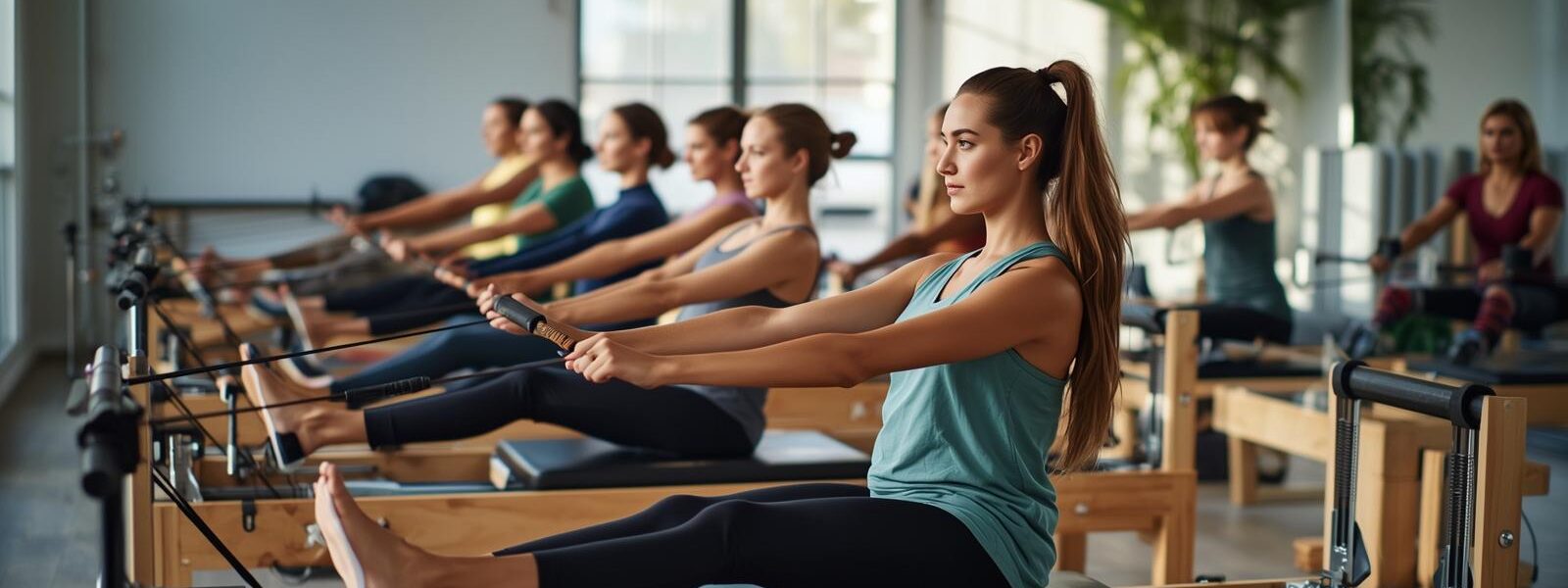
Our Mat course runs to 231 hours and our Reformer course to 221 hours. Mat work happens largely on the floor, building a full-body, equipment-free class and learning to see alignment and control with nothing but gravity to argue with. Reformer work happens on the machine, learning how springs, straps and a moving carriage change what a body can feel, and what you, as the teacher, can ask of it.
Neither is a cut-down version of the other, and neither is the “proper” one. They’re different crafts, and plenty of good teachers only ever do one of them. Details of what’s covered, and current dates, are on the Mat course page and the Reformer course page above.
So which should you start with?
A few honest questions tend to settle it faster than any syllabus comparison.
Where do you picture yourself teaching in a year? Community halls, gyms or group mat classes point towards Mat. A studio with reformers points towards Reformer.
Do you already have reformer access? Training on equipment you can keep practising on, through a studio, a gym or your own machine, tends to make the hours land faster and stick better.
Are you drawn to one kind of movement problem more than the other? Some teachers love the floor, the subtlety of controlling a body with no external resistance. Others love the carriage, the immediate, visible feedback a spring gives a client who’s quietly cheating a movement. Neither instinct is wrong, and it’s worth paying attention to which one is yours.
For a good number of our clients turned teachers, the decision is simpler still: they loved what they experienced on the Reformer as a student, and they want to learn to teach exactly that, properly, from the start. There’s nothing lesser about skipping Mat if that’s genuinely where your interest and your future clients are.
If you’re already Mat-trained and wondering whether Reformer is worth adding, the question flips slightly: not “where do I start” but “what can I now offer that I couldn’t before.” A lot of upskilling teachers find that’s reason enough on its own.
Can you do both eventually?
Most teachers do, in time, want both. That’s what our Comprehensive course (459 hours) is for: Mat and Reformer together, plus the additional work that joins them into one coherent way of teaching.
There’s no penalty for doing Reformer first and adding Mat later, or the other way round. The hours and the learning carry forward. You’re simply building the same teacher in a different order.
Can you train online, or does it have to be in person?
Teaching a body well is something you learn by having your own hands and eyes corrected by someone else’s, not through a screen. So the practical teaching hours, on both Mat and Reformer, happen in the room, with real bodies to work with and a mentor watching closely. Some of the supporting theory can be worked through independently around your existing commitments, but the core of each course is in-person, by design, not by limitation.
What about fitting training around a full-time job?
This is usually the second question, straight after the Mat-or-Reformer one. Course dates are set in blocks rather than daily term-time, precisely because most people training with us are already working, teaching other things, or raising a family. The practical way to answer this for yourself is to look at the dates on the course page you’re considering and hold them up against your own calendar before you commit to anything.
Is the qualification recognised?
Worth answering honestly rather than glossing over. “Recognised” means different things depending on who’s asking, a gym, a studio, an insurer, a prospective client. Rather than make a blanket claim here, we’d rather you ask a specific question of us, and of anyone else you’re considering training with: what, exactly, will this let me do, and who has actually accepted it so far? We’re always glad to talk that through directly, studio by studio and situation by situation, rather than leave it as a tick-box line on a web page.
Where to go from here
If Reformer is the one pulling at you, our next London Reformer course opens for January 2027. Have a look at the Reformer London course page for dates, fees and what the training actually involves. No pressure, just the detail you need to decide for yourself.