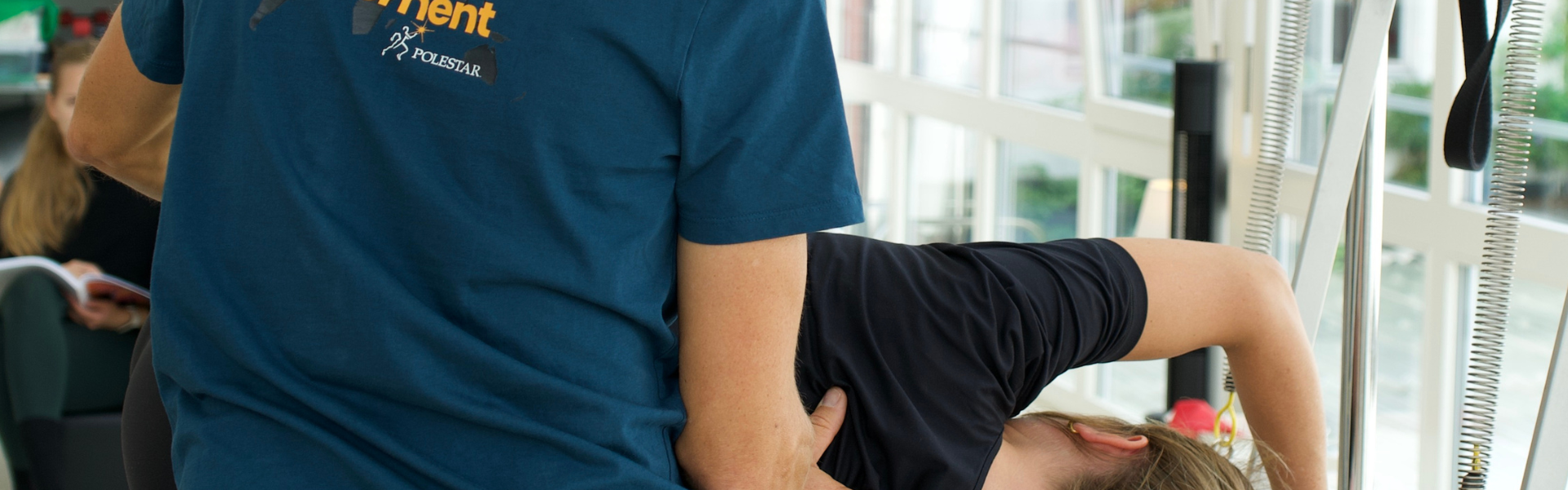
What is pathokinesiology, and why should movement teachers care?
Pathokinesiology is the study of how pathology, injury and disease change the way the body moves. It sounds like something only a clinician needs. In practice, most experienced Pilates teachers are already doing a version of it every week. They just haven’t had a name for it.
Here’s the moment that makes it real rather than theoretical. A teacher is walking the studio floor and catches something odd: a client she’s taught for years is working the footstraps on the reformer, and the movement just isn’t quite right. Nothing dramatic. She doesn’t diagnose anything, she simply flags it. Within the hour, the client is on her way to hospital. What looked at first like a stroke turns out to be something more serious still, caught early because someone who knew how this person normally moved noticed when she didn’t. That story came up on a recent Pilates Hour with Dr Brent Anderson and Shelly Power, and it explains pathokinesiology better than any definition could.
What does “pathokinesiology” actually mean?
Break the word apart and it says exactly what it is: patho, disease, and kinesiology, the study of movement. The term goes back to Helen Hislop, who spent 23 years as chair of physical therapy at the University of Southern California and built the profession’s first PhD programme there (USC history, via The Downey Patriot). Her own definition was blunt: any pathology that impairs movement is her specialty.
For a physiotherapist, that’s a job description. For a Pilates teacher, it’s closer to a lens: not a licence to diagnose, but enough understanding of how disease and injury change movement to recognise it, work safely around it, and know when to bring someone else in.
Why “I’m just a Pilates teacher” undersells what you do
It’s a phrase most teachers have said about themselves at some point, usually to excuse not knowing something. But compare the training hours. Most Pilates teachers go through as much movement-specific training as many clinicians, and often it runs deeper, because movement is the whole curriculum rather than one module inside a far wider medical degree. That doesn’t make a Pilates teacher a clinician. It does mean the thinking behind pathokinesiology, understanding normal movement well enough to spot abnormal, is closer to home than it feels. As Dr Brent Anderson put it on the episode: “Never use the word ‘I’m just a movement practitioner.’ You are the movement practitioner.”
Where’s the line between noticing and diagnosing?
This is the part worth getting right, because it’s also where confidence tends to wobble. A useful way to think about it: you are an extender of a client’s treatment plan, not a replacement for one. The habit worth building is thinking in indications as much as contraindications, not just what to avoid, but what’s actually indicated for this person, this pathology, this day.
That distinction keeps a teacher inside their scope of practice while still bringing real value. You are not diagnosing a skin lesion, a change in gait or a lump. You are noticing it, and finding a respectful way to ask whether it’s been checked. You are not diagnosing. You are promoting health and wellbeing, which is a different, and entirely legitimate, thing.
Movement-related conditions are also just common. Musculoskeletal conditions alone affect an estimated 1.71 billion people worldwide, and are the leading global contributor to disability (World Health Organization). Most teachers are already working with clients managing something, whether or not it’s ever been named out loud.
What this looks like with a real client
Take Sally: 82, active, family-centred, with confirmed osteoarthritic changes in her knees and hips. The system affected is musculoskeletal, specifically the joint. The goal isn’t to treat the arthritis. It’s to protect what actually matters to Sally, squatting down with a grandchild, walking to the shops without pain.
The thinking runs like this. Take load off the irritated joint by improving movement elsewhere, in the ankle, the hip, the back. Avoid heavy load at end of range. Keep the joint moving, because movement is part of what keeps it comfortable, not something to fear. None of that requires a diagnosis beyond the one Sally already has. It requires a teacher who understands what the diagnosis does, and doesn’t, mean for how a body can move.
It’s also worth saying to any client who’s anxious about a new diagnosis like this. Anderson’s own line to patients: “Everybody over 60 has osteoarthritis. You move, and you’re at the right place, and we’re going to teach you how to move.” Movement isn’t the enemy here. It’s part of the answer.
Is this worth your time?
None of this is about collecting letters after your name or practising outside your scope. It’s about the confidence that comes from understanding why, so that when a client asks a hard question, you’re reaching for a real, useful answer, or a well-judged referral, rather than “I’m not sure.”
If this way of thinking is one you’d like to build on with Anderson himself, Polestar UK is hosting a one-day Introduction to Pathokinesiology with him in person in London on Sunday 29 November 2026. If you’re curious whether it’s for you, the course page has the details.