Osteoporosis and Pilates: building bone confidence without fear
A client in her eighties, a lifelong dance teacher, had been told by her doctors never to bend her spine forward again. And yet she still put on her own shoes every morning, still got herself to the bathroom, still lived an independently mobile life, each of those small daily tasks needing a bit of spinal flexion.
That contradiction sits right at the centre of pilates for osteoporosis. It isn’t movement itself that puts fragile bones at risk. It’s force. Load a flexed or rotated spine hard, and there’s a problem. Keep that spine in a comfortable, supported position while you load the hips and legs, and there’s a great deal of safe, useful, confidence-building work still to do.
None of this overturns the standard precautions on exercise and osteoporosis, and with osteoporosis itself, a T-score of -2.5 or lower on a DEXA scan, you should stay with them. The more useful question for a teacher is what those precautions are actually protecting against, and where the line between risky and merely unfamiliar really sits.
Osteopenia or osteoporosis? The distinction that changes your approach
Osteopenia and osteoporosis get lumped together in everyday conversation, but a DEXA scan draws a clear line. A T-score of -1 to -2.5 is osteopenia, a lower bone density than average. Below -2.5 is osteoporosis, a firm diagnosis with a meaningfully higher fracture risk (NHS, osteoporosis).
The two deserve different responses. With osteoporosis, stay with the standard precautions. With osteopenia, especially in a client who’s otherwise strong, active and well-conditioned, there’s more room to work with: the research shows the absolute risk of fracture from ordinary physical activity is low.
Take a client like Barbara: 56, newly diagnosed with osteopenia at a T-score of -2.0, cycling regularly and about to take up pickleball with her husband. Her doctor told her to be careful bending forward. She feels no pain doing it. That gap, between a blanket precaution and what a particular body can actually do, is exactly where your judgement as a teacher earns its keep.
What does pilates for osteoporosis actually need to avoid?
The standing guidance, echoed in the UK’s own 2022 consensus statement on exercise and osteoporosis, is to avoid forceful movements involving spinal flexion, side bending or rotation, particularly when they’re loaded or resisted (BJSM, “Strong, Steady and Straight”). That statement also recommends spinal extension work for posture, and strength and balance training to reduce falls, while limiting high-impact loading for anyone who has already had a vertebral fracture.
Mark the word force. A roll-up, a neck pull, weighted sit-ups: all of these combine flexion with real compressive load on the front of the vertebral body, exactly where the fragile, honeycomb-like trabecular bone sits. That’s where a fracture is most likely if one happens, and there’s rarely any warning before it does.
Functional flexion is a different matter. Putting on socks, reaching into a low cupboard, getting up off the floor: these all involve some flexion, and a client should feel comfortable doing them, not frightened away from daily life. “I’m not going to go against any of the standard recommendations for osteoporosis in exercise, but I am going to challenge them a little,” is how Dr Brent Anderson put it in a recent Pilates Hour session. The aim isn’t zero flexion. It’s no forced, loaded flexion.
What’s safe, and worth building, in the studio?
A segmental or hinge bridge, led by the glutes and hamstrings rather than a crunch through the front of the spine, stays well within safe limits for either osteopenia or osteoporosis, so long as it’s taught without breath-holding or straining.
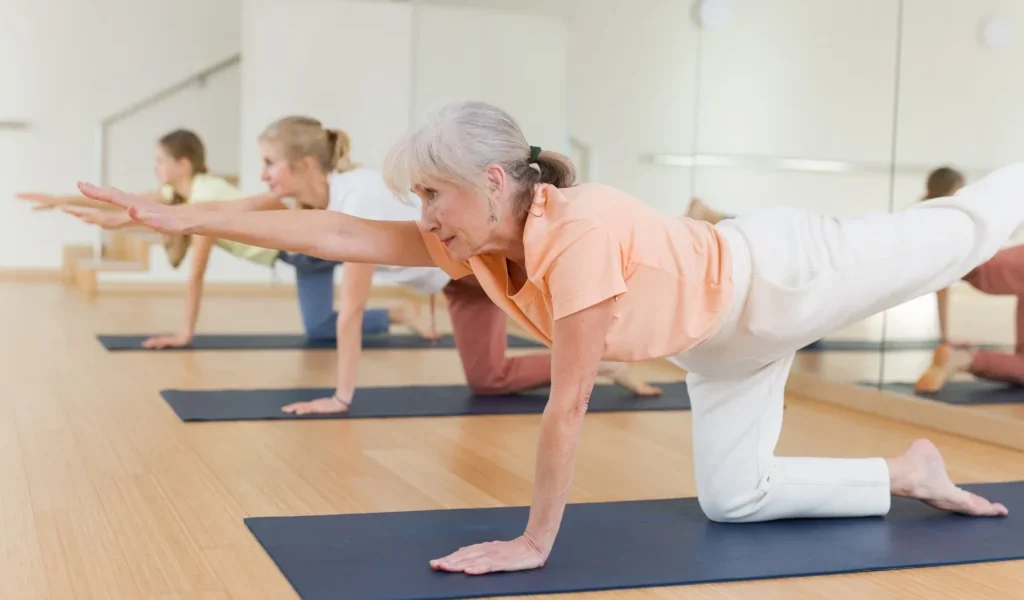
Beyond that, squats, standing balance work and axial loading through the legs and hips are some of the most useful tools you have. They build the kind of bone-loading strength that resistance training offers, without putting the spine itself through flexion or rotation under load. Thoracic extension work and mobility through the chest matter too, especially for a client who sits a lot and has started to round through the upper back.
Falls prevention belongs in the same programme. A fracture is often the result of a fall rather than the cause of one, so balance and confidence in standing, turning and recovering from a stumble matter just as much as any exercise choice on the mat.
Building confidence instead of fear
Overly restrictive movement advice can do its own kind of harm. A client who’s frightened of bending moves less, loses strength and balance, and ends up more likely to fall, not less. “Overly restrictive movement boundaries can cause harm by inducing a fear of movement, leading to muscle wasting, poor balance, and the ultimate increase in fall risk,” is how Anderson put it, and it’s worth sitting with.
None of this replaces a client’s own medical advice. A diagnosis of osteopenia or osteoporosis should always sit alongside guidance from a GP, physiotherapist or consultant, and this piece is general education for teachers, not a substitute for that. What you can offer, working alongside that medical picture, is an honest assessment of what this particular body can do: a programme built on distributing movement and force rather than avoiding it altogether, and a client who leaves feeling more capable, not less.
That’s the work. Teach the body in front of you, not the diagnosis on the page.
If this kind of clinical reasoning is the part of teaching you find most interesting, Polestar UK’s course calendar is worth a look, including the Comprehensive and continuing education programme: https://polestarpilates.co.uk/
Sources used this week
– NHS, Osteoporosis prevention: https://www.nhs.uk/conditions/osteoporosis/prevention/
– Gregson et al., “Strong, steady and straight: UK consensus statement on physical activity and exercise for osteoporosis”, British Journal of Sports Medicine, 2022 (PubMed): https://pubmed.ncbi.nlm.nih.gov/35577538/
– BMJ, summary of the UK consensus statement: https://blogs.bmj.com/bjsm/2023/10/30/steady-and-straight-uk-consensus-statement-on-physical-activity-and-exercise-for-osteoporosis/
– Pilates Hour #287, “Osteoporosis: A Movement Case Study” https://youtu.be/b_t5d2zVrMM, Dr Brent Anderson, 18 June 2026
– Polestar Pilates Hour, live webinar series: https://polestarpilates.com/webinar/